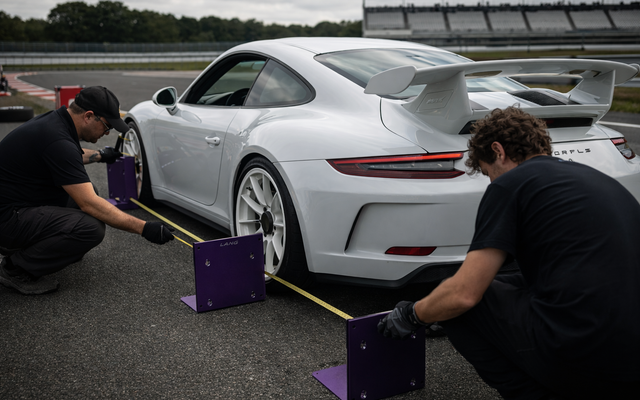
In the high-stakes world of modern professional oversteer competition, podium finishes is far more than exclusively a product of raw torque or behind-the-wheel courage. Rather, it has become a multifaceted engineering challenge that demands a scrupulous marriage of selecting a proven car, outfitting it with the highest-quality competition parts, and, most essentially, comprehending its real-time performance on the track through sophisticated vehicle dynamics analysis tools. This exhaustive handbook will serve as your master plan from the very first concept of a competition vehicle right through to the last telemetry-optimized refinements that transform a capable vehicle into a predictable champion. We will thoroughly explore the art and science of chassis dynamics adjustment, demonstrating how a advanced suspension tuning tool like precise measurement hardware eliminates assumptions and offers unmatched insight into your vehicle's true dynamics.
The foundation of any successful drift machine is, undoubtedly, the chassis itself. Several platforms have attained renowned standing within the worldwide drifting community due to their natural balance, strong design, and the immense range of performance components available. Picking the correct platform is the first and most important choice a builder will make. To illustrate, the the E36 generation BMW is widely regarded as one of the finest all-around cars for drifting of all time. Its excellent 50/50 weight distribution, combined with a RWD configuration and extremely reliable straight-six powerplants, forms a platform that is at once easy to handle for beginners and highly capable in the hands of a expert driver. The evolution of this concept, the BMW E46, builds upon these strengths with a even more refined chassis, increased track for improved confidence, and even increased turning capability directly from the manufacturer. A distinct dominant platform in the top-level arena is the Corvette C6.
This V8-powered sports car introduces a distinctive set of advantages to the drifting world, including a lightweight aluminum chassis, a transaxle-style drivetrain component that helps create an perfect weight distribution, and the tremendous thrust of a large-displacement LS V8 motor. This combination makes it an utter monster on track, able of starting and sustaining extended drifts with relatively easy application of acceleration. For builders seeking remarkable value, the Nissan Z33 stands out as a excellent example. It is delivered from the manufacturer with a rigid chassis, a competent original locking differential, and the free-revving VQ35DE motor that delivers sufficient power and torque for learning and moving up in the activity. Its successor, the Nissan 370Z, brings additional refinements in chassis stiffness, handling precision, and peak engine output, establishing its position as a favorite choice among serious pilots. Additional historic cars that warrant consideration include the agile unique Mazda FC, the most popular S13 Silvia/240SX, the torque-rich Ford SN95, the modern BMW E90, and the tiny yet unbelievably engaging and teachable MX-5 Miata. All of these platforms gives a different palette of characteristics, difficulties, and possibilities, but they all share the core elements essential to serve as a serious drift car.
However, choosing the right car is just the first step. To release the complete potential of any of these cars, major modifications to the steering system and damping and springing systems are utterly essential. This is where the realm of precision drift-spec parts becomes sharp importance. The one most impactful improvement for a serious drift car is the integration of a high-performance steering angle kit. These advanced systems, like those engineered by specialist companies like SLR Speed, are engineered to dramatically increase the vehicle's possible lock-to-lock rotation. A OEM road car is highly restricted in how far its steering tires can rotate, a engineering compromise for on-road operation. In oversteer driving, conversely, aggressive steering input is frequently needed to manage and sustain a drift. An steering kit substitutes the factory steering knuckles, linkages, and potentially suspension arms with components that permit the steered wheels to reach angles over 70 or even 80 degs, compared to a normal stock setting of around 40 to 50 °.
This tremendously expanded lock provides the operator with dramatically more authority during a slide, making it considerably easier to begin a drift, hold it through a extended bend, and switch smoothly from one angle to another. The contrast in drivability is truly revolutionary. Combined with a properly specified angle kit is the just as critical modification to the chassis's damping system. Generic or even premium sport adjustable suspension are generally not designed for the specific and brutal requirements of competitive oversteer. A dedicated pair of suspension units is of utmost importance. These engineered dampers feature specific valving and spring rates that are tuned for the extreme load shifting that is typical of aggressive driving. When a driver starts a slide, the chassis's weight is shifted violently to the front of the bend. Proper competition dampers handle this shift in a predictable manner, enabling the vehicle to stabilize quickly and offering the driver clear response through the controls and seat. They additionally enable accurate setting of ride height, shock absorber firmness, and cross-weight, which are all key elements of optimizing the chassis's dynamics to a specific track or driving technique. In combination, a top-tier drift angle kit and a expertly selected pair of performance coilovers form the core mechanical base upon which all future optimization is built.
Once the essential components is in place, the next essential phase in the development is the detailed adjustment of the chassis's wheel angles. This is the world of car suspension tuning, a methodology that can feel intimidating to the newcomer but is, in reality, the defining factor to converting a collection of fast components into a unified and controllable machine. The most debated aspect of alignment for oversteer is undoubtedly camber. Camber is the inclination of the tire relative to the perfectly straight plane when viewed from the forward of the vehicle. When the upper part of the tire is leaning towards the chassis, this is referred to as negative camber. In sliding, negative camber on the steering wheels is generally applied and is considered necessary. The reason is intrinsically linked to vehicle dynamics.
When a chassis is turning at limit angles, the chassis rolls towards the outer of the turn. This body roll makes the outer front tire to reduce its best contact patch with the track surface. By applying negative camber, the tire is pre-angled suspension tuning tool to account for this tilt. As the car leans into the turn, the outside front tire flattens out on the track, optimizing its bite at the critical moment when it is needed most for steering authority. Usually, front axle adjustments for a competition drift car range from approximately -3 degrees to as much as -5 degrees or even more, contingent on the parameters of the vehicle geometry, compound type, and operator feel. The back tires also employ inward lean, but the angles are typically more modest and less aggressive than the front axle. Too much inward lean at the rear can cause the vehicle to excessively loose and difficult to control on power application, as it diminishes the available grip area of the powered wheels during forward power delivery. Thus, rear axle adjustments are commonly in the vicinity of -1 degree to -3 degrees, achieving a careful compromise between offering enough cornering traction to aid in initiating and sustaining the angle while simultaneously keeping effective grip for power-down the bend. alignment is only one component of the larger alignment picture, which furthermore involves toe angle, caster angle, and steer correction adjustment.
Toe angle refers to the orientation of the tires when viewed from above. Inward toe means the front edges of the tires are closer together than the trailing edges, while negative toe means the reverse. For drifting, a slight amount of front toe out is often run to quicken the initial directional reaction, making the chassis feel more responsive and ready to start a drift. Rear axle toe is typically set to zero or a very minute amount of toe-in to promote stability under power. Caster is the longitudinal or backwards tilt of the kingpin axis when viewed from the lateral of the vehicle. More positive caster enhances steering feel and high-velocity stability, and it additionally boosts camber gain during cornering, which is very advantageous. Setting these values is a complex interplay where a adjustment to one parameter can and will impact the remaining parameters. The conventional method for setting a car's alignment for sliding has historically been a labor-intensive process of experimentation and feeling. A tuner or team would make a adjustment based on a hunch, run the car on track, rely on the driver's subjective feel and feedback, and then make a further change. This loop would continue again and again until the chassis felt "right" or the allotted testing session ran out. This methodology is not just exceptionally slow in terms of hours and tires, fuel, and parts, but it is also fundamentally flawed.
Pilot perception is a infamously unreliable measurement tool, affected by numerous factors such as tiredness, evolving track conditions, temperature, and just the focus of the operator on that given session. What feels "oversteery" on one run might feel "tight" on the subsequent run, resulting in confusing feedback and counterproductive changes. This age-old challenge in car suspension tuning is specifically where modern technology has made its mark to transform the landscape.
The development and adoption of advanced drift telemetry software has ushered in a new era for tuning and refining competitive sliding vehicles. This new generation of platforms, represented by groundbreaking solutions like modern telemetry hardware, function by physically capturing the actual dynamic performance of the vehicle as it is being driven on the circuit. As opposed to depending on personal feedback, these systems gather measurable metrics on critical variables such as damper compression and extension, wheel speed, acceleration forces, lock position, and accelerator and brake pedal input. This raw information flow is then processed by advanced applications that can visualize and analyze the data in a actionable format. For the first time, tuners and crews can observe specifically what the car is doing at any given moment of a lap. This function revolutionizes the entire chassis setup process. Consider the aforementioned task of optimizing the front axle negative camber for a specific vehicle. As an alternative to introducing a change from -3 degrees to -3.5 degrees and then testing many laps to try and "sense" a change, a telemetry system can give real-time and definitive information. The software can show in a chart how the suspension's grip is performing during the critical stages of a angle: turn-in, mid-corner, and changing direction. It can show if the current value is enabling the outside front tire to keep ideal loading or if the tire is working inefficiently on its outside shoulder.
The tool can after analysis make empirical advice for adjustment. Perhaps the telemetry indicates that the tire is still stressing its edge at -3.5 degrees of negative camber, implying that a move towards angle, say -4 degrees, might be beneficial. On the other hand, the data might indicate that the tire is failing to reaching heat or that the inside edge is degrading too quickly, which could indicate that there is overly aggressive angle and a modest decrease back to -3.2 degrees would be better ideal. This degree of accuracy and useful intelligence was literally impossible in the days of solely manual tuning.
The impact of employing a dedicated vehicle dynamics tool extends far beyond merely dialing in camber angles. It becomes an essential damper adjustment manual that is specific to your specific car. When fine-tuning the damping clickers on your suspension, instead of relying on general tips or copying another team's settings, you can utilize the telemetry to see how the vehicle is reacting in response to your changes. The software can graph the wheel movement trace over a section of track, showing if the coilovers are controlling the body movement effectively or if they are permitting the vehicle to oscillate too much after a flick. It can aid in pinpointing issues like hitting the bump stops or excessive extension, permitting you to make informed decisions to spring preload, rebound/compression values, or stance. This approach translates just as well to the intricate task of car alignment tuning. In addition to camber angle, the tool can give data into how adjustments to toe and caster angle are impacting the vehicle's handling during various phases of a lap. For instance, it can assist you to determine the optimal amount of front axle negative toe for your coilover setup tips particular steering setup and competition technique by showing the quickness of turn-in response and the stability of the vehicle at maximum steering angle. This makes the tool an extremely useful performance optimization handbook that is constantly calibrated by the actual performance of your personal chassis on the tarmac. It shifts the entire project from a subjective skill into a methodical engineering exercise.
Furthermore, the application of a platform like GripDial is in no way restricted to experienced engineers with large budgets. For the club-level driver, it functions as an incredible equalizer. It in essence gives the builder with the insight of a full-time dynamics engineer without needing the associated cost. It speeds up the development time by delivering definitive solutions to challenges that would normally take seasons of experience to answer. A builder can learn how their particular chassis behaves to various inputs, building a more intuitive knowledge of car control in the process. It additionally democratizes professional chassis dynamics techniques, allowing every enthusiast with the ambition to refine their machine to do so in a systematic and successful manner. This is notably important in a discipline like oversteer competition, where setup know-how has in the past been a highly secretive commodity among professional teams. Now, that knowledge can be in the garage of every motivated enthusiast.
In summary, the process to building and tuning the perfect high-performance drift car is vehicle dynamics tool a multi-stage mission that seamlessly integrates classic mechanical principles with cutting-edge digital technology. It begins with the strategic pick of a legendary car, then built upon the application of non-negotiable performance parts like drift-spec angle modification systems and expertly selected competition adjustable dampers. The build then moves into the detailed phase of chassis dynamics adjustment, where parameters like negative camber, toe, and caster angle are precisely adjusted to complement the vehicle's modified hardware and the driver's individual style. Ultimately, and what genuinely differentiates the modern methodology from the traditional methods, is the integration of a advanced suspension tuning application. This system eliminates the uncertainty and waste of solely seat-of-the-pants tuning by providing objective, live data on how the car is really behaving. It acts as an indispensable suspension tuning tool, a actionable coilover setup manual, and a all-in-one performance analyzer. Together, this integrated philosophy ensures that each and every component of the drift car—from the choice of the car to the final adjustment on the suspension—is optimized for maximum competitiveness on the competition venue. It represents the complete progression of the sport of drifting, merging mechanical driving skill with surgical vehicle setup to create the most competitive cars attainable.